Global Space Endeavours: A Year of Milestones and Innovations
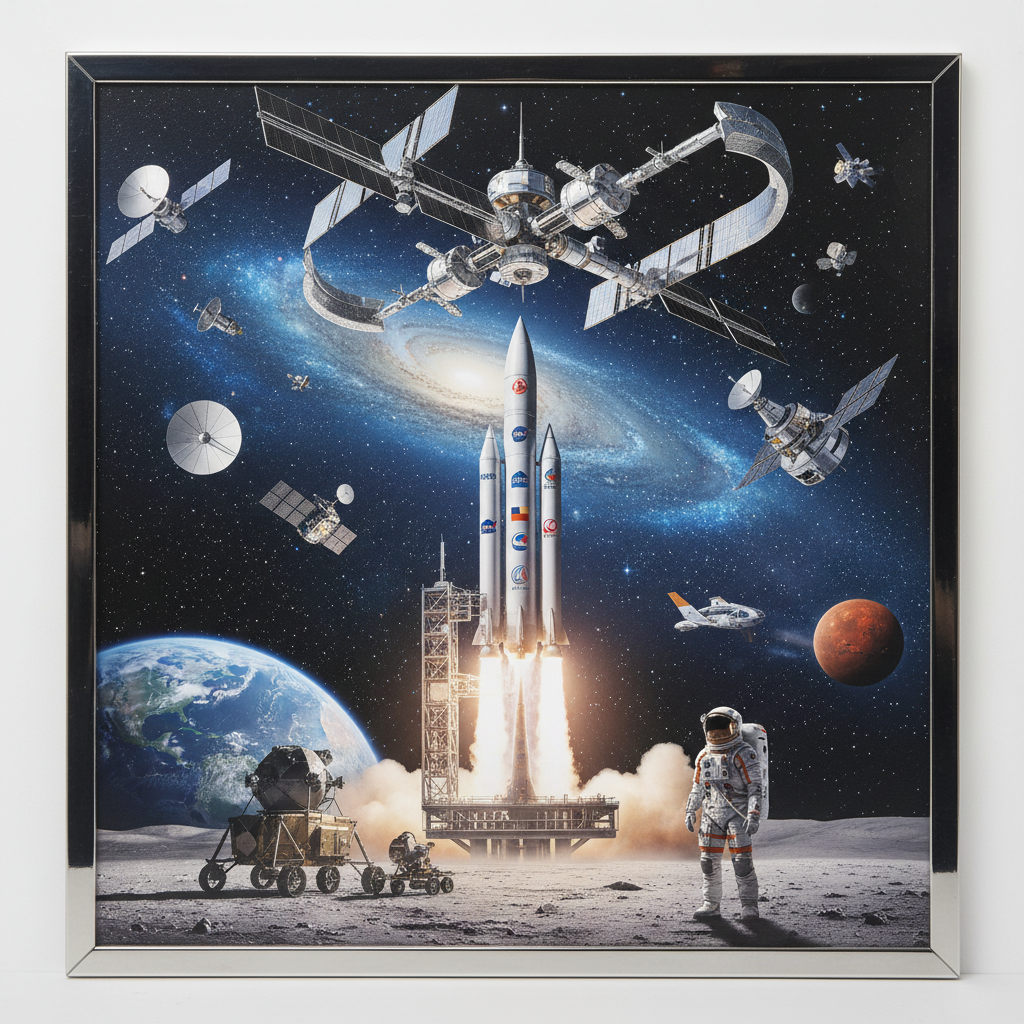
The year 2025 has been a remarkable period for space exploration, marked by significant achievements and groundbreaking missions across the globe. From the United States to China, and from Europe to Iran, nations have demonstrated their commitment to advancing our understanding of the cosmos. This article provides an overview of the most notable developments in the world of space science and technology over the past year.
NASA's Pioneering Initiatives
In 2025, NASA has been at the forefront of space exploration, initiating several ambitious projects aimed at deepening our understanding of the universe and our place within it.
- Habitable Worlds Observatory (HWO): NASA has allocated funding and established contracts for the development of the HWO, a next-generation space telescope designed to search for signs of alien life. Scheduled for launch in the late 2030s or early 2040s, the HWO will feature cutting-edge technology, including an ultra-stable optical system and a novel coronagraph capable of detecting light passing through the atmospheres of distant exoplanets. Seven companies, including Lockheed Martin, Northrop Grumman, and BAE Systems, have been awarded three-year fixed-price contracts to overcome engineering challenges associated with this ambitious project. NASA Administrator Jared Isaacman emphasized the urgency and innovation required to bring this mission to fruition. ([space.com](https://www.space.com/space-exploration/search-for-life/nasa-funds-new-tech-for-upcoming-super-hubble-to-search-for-alien-life-on-other-planets-we-intend-to-move-with-urgency?utm_source=openai))
- Europa Clipper Mission: In October 2024, NASA launched the Europa Clipper spacecraft aboard a SpaceX Falcon Heavy rocket. This mission aims to conduct detailed reconnaissance of Jupiter's icy moon, Europa, to assess its habitability and potential for supporting life. The spacecraft is scheduled to arrive at Jupiter in April 2030, marking a significant milestone in the study of outer solar system bodies. ([prnewswire.com](https://www.prnewswire.com/news-releases/nasa-accelerates-space-exploration-earth-science-for-all-in-2024-302325349.html?utm_source=openai))
China's Rapid Advancements
China has made significant strides in its space programme, setting new records and achieving remarkable milestones throughout 2025.
- Record Launches and Reusable Rockets: In 2025, China conducted over 80 orbital launch attempts, setting a new national record. Among these, the country achieved its first reusable rocket test by commercial company Landspace and prepared for the launch of the reusable Long March 12A. Despite two launch failures, the state-run Long March series maintained a perfect track record since 2020. ([space.com](https://www.space.com/space-exploration/launches-spacecraft/record-launches-reusable-rockets-and-a-rescue-china-made-big-strides-in-space-in-2025?utm_source=openai))
- Lunar Mission Preparations: China made significant progress in its crewed lunar mission plans, with hardware tests for the Long March 10 rocket, the Lanyue lander, and the Mengzhou spacecraft. These developments have raised concerns that China might land astronauts on the Moon before NASA's Artemis 3 mission. ([space.com](https://www.space.com/space-exploration/launches-spacecraft/record-launches-reusable-rockets-and-a-rescue-china-made-big-strides-in-space-in-2025?utm_source=openai))
- Asteroid Sample Return and Satellite Refueling: China successfully executed the Tianwen 2 asteroid sample return mission and captured images of interstellar comet 3I/ATLAS via the Tianwen 1 Mars orbiter. Additionally, China pioneered a satellite refueling operation in geostationary orbit, showcasing its growing capabilities in space technology. ([space.com](https://www.space.com/space-exploration/launches-spacecraft/record-launches-reusable-rockets-and-a-rescue-china-made-big-strides-in-space-in-2025?utm_source=openai))
Iran's Satellite Launches
On December 28, 2025, Iran launched three domestically produced satellites—Paya, Zafar 2, and Kowsar—into space aboard a Russian Soyuz 2.1b rocket. These Earth-observation satellites are intended to support Iran in monitoring agriculture, mapping natural resources, and analyzing environmental data. Despite facing international sanctions due to its nuclear programme, Iran emphasized the achievement as a testament to its scientific capabilities. ([space.com](https://www.space.com/space-exploration/launches-spacecraft/iran-says-it-launched-3-satellites-to-space-on-russian-rocket-report?utm_source=openai))
Commercial Space Stations and Private Initiatives
The private sector has also played a pivotal role in advancing space exploration, with companies like Vast leading the way in commercial space stations.
- Vast's Haven-1 Space Station: Vast, a California-based startup, is seeking scientific research proposals for its Haven-1 private space station, set to launch in the second quarter of 2026 aboard a SpaceX Falcon 9 rocket. The 14,000 kg lab will become the first crewed commercial space-based research and manufacturing facility in low Earth orbit. Haven-1 aims to facilitate a range of experiments, including pharmaceutical development, stem cell and human research, plant growth, and technology demonstrations. ([space.com](https://www.space.com/space-exploration/human-spaceflight/experiments-on-a-private-space-station-vast-asks-scientists-for-research-proposals?utm_source=openai))
Challenges in Space Debris Management
In 2025, space debris led to a serious orbital emergency when China's Shenzhou-20 spacecraft developed cracks in its viewport due to a debris strike, delaying crew return and triggering the nation’s first emergency space launch. This incident underscored the growing risks posed by the estimated 130 million pieces of human-made orbital debris. Experts advocate for improved global transparency, data reliability, and mission governance to mitigate these risks and ensure the sustainable use of Earth's orbit. ([space.com](https://www.space.com/space-exploration/launches-spacecraft/space-debris-led-to-an-orbital-emergency-in-2025-will-anything-change?utm_source=openai))
Looking Ahead
The year 2025 has been a testament to the rapid advancements in space exploration, with nations and private entities worldwide contributing to our understanding of the universe. As we look ahead, the continued collaboration and innovation in space technology promise even more exciting developments in the years to come.


